
|
At long last we have been able to enjoy some clear skies and the Moon was prominent high in the sky last month with a close approach to Mars in the middle of April and a super moon on the 27th April. Observing The following charts represent the night sky at 10.00pm BST on the 8th of May and at 9.00pm BST on the 23rd May. To use the chart, face south at the appropriate time with the bottom of the chart towards the southern horizon and you will see the stars in the chart. 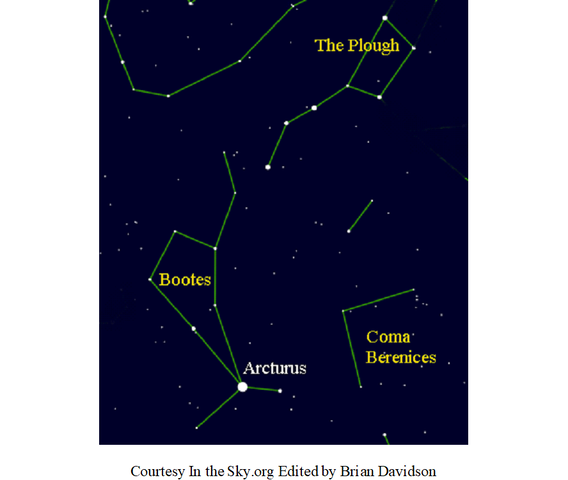 We’ll start from The Plough which we discussed last month and you will notice that it has continued on its anti-clockwise journey round the pole star and is now slightly west of south with the middle of its handle at your zenith. Follow the arc of the handle of the Plough downwards round to the star, Arcturus, which has the distinction of being the second brightest star visible in the northern hemisphere at magnitude -0.05. Also known as alpha Boo (alpha meaning it is the brightest and Boo a short form of Bootes). It is an orange giant nearing the end of its life and relatively close at a distance of 36 light years. It is the brightest star in the constellation Bootes (The Herdsman) and again it is difficult to distinguish such a figure whereas the Kite asterism is easier to see and is what most people recognise as Bootes. In mythology the constellation Coma Berenices is supposed to represent the locks of Queen Berenice of Egypt but it contains no stars brighter than magnitude 4 so doesn’t present much to observation with the unaided eye. I recall that it was an answer to a quiz question so if it comes up again at least you will have heard of it. 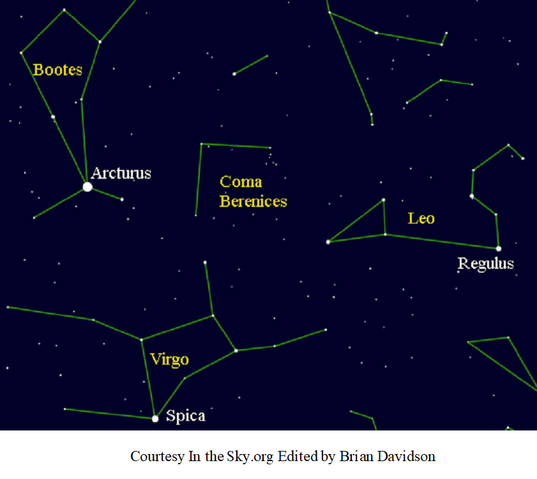 Carry on following the curve of the arc from Arcturus for about the same distance again until you see another bright star. This is Spica the brightest star in the constellation Virgo- The Maiden. Virgo is of course one of the zodiacal constellations as it lies on the ecliptic. Spica is a blue-white star with an average magnitude of about 1 and is 260 light years from Earth.
It may be easier to memorise these two star hops using the expression (Arc on to Arcturus and Speed on to Spica). Now look to your north west and from last month you should recognise Leo- The Lion with Regulus shining brightly. Turn to face Leo then look up and you are back at the Plough. Something to look out for The challenge this month is to spot the planet Mercury. This is always quite tricky because it is low in the sky and only visible for a short time after sunset in the North West sky. It will be at its brightest early in the month but close to the Sun and it will be at its highest altitude on the 16th May. You will need a clear view to your West/North West horizon and if you have the use of binoculars so much the better. On the 4th May it will be on its easterly journey just below the Pleiades and above and to the left of our old faithful Venus which is significantly brighter. A better opportunity to spot it arises on the 13th May when a crescent Moon, Mercury and Venus form an isosceles triangle about 40 minutes after sunset. I can’t finish without saying how good it is to have Venus back in the evening sky and it will be just above a crescent on the 12th May. Clear skies.
0 Comments
Leave a Reply. |
AuthorWMA members Archives
July 2024
Categories |
 RSS Feed
Proudly powered by Weebly