|
With an abundance of clear skies the two lunar close approaches in May did not disappoint. On the 25th a 4 day old crescent Moon and Venus gave a striking bright display close together while the next day on the 25th if you waited a little later in the evening till it was darker the Moon sat just above Mars with a nice inverted triangle to their right formed by Castor, Pollux and Venus- a delight to see. Observing The following chart represents the night sky at 11.00pm BST on the 8th of June and at 10.00pm BST on the 23rd June. To use the chart, face south at the appropriate time with the bottom of the chart towards the horizon and you will see the stars in the chart. At this time of year it is necessary to stay up later to get reasonable darkness. 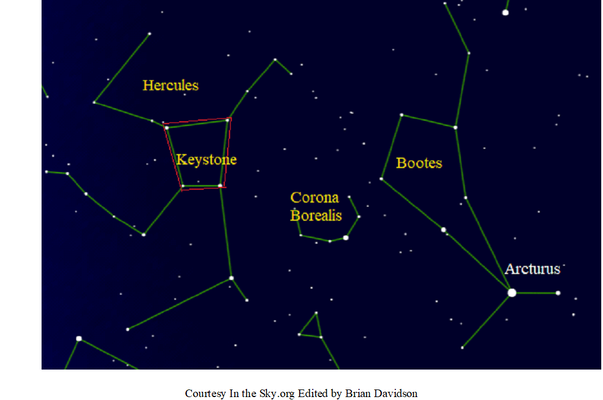 Last month we followed the arc of the handle of The Plough down till we found the bright star Arcturus in the constellation Bootes- The Herdsman. We do the same this month and to the east of Bootes is the small but distinctive constellation, Corona Borealis- The Northern Crown. It consists of seven mostly faint stars in a horseshoe shape if you prefer that to a crown. Further east still, about 30 degrees (three clenched fists at arm’s length) to the left of Bootes you will see four relatively faint stars in the shape of a quadrilateral. This is an asterism called The Keystone (oulined in red on the chart) and is part of the constellation Hercules- the strong man in Greek mythology. It is difficult to see any resemblance to a man but the Keystone asterism is another good signpost in the sky. The second chart (below) shows two more zodiacal constellations and a bright star. Follow the arc of the Plough’s handle past Arcturus for about the same distance again until you see another bright star. This is Spica, at magnitude1.0, the brightest star in the constellation Virgo- The Maiden, and the 11th brightest star in the northern hemisphere. Spica is meant to represent an ear of wheat in the girl’s hand. Below and to the left of Virgo is another small and faint zodiacal constellation Libra- The Scales. Unfortunately it has little to offer the amateur observer. Just as Virgo is the only only female sign of the zodiac so Libra is the only object as opposed to a living creature. 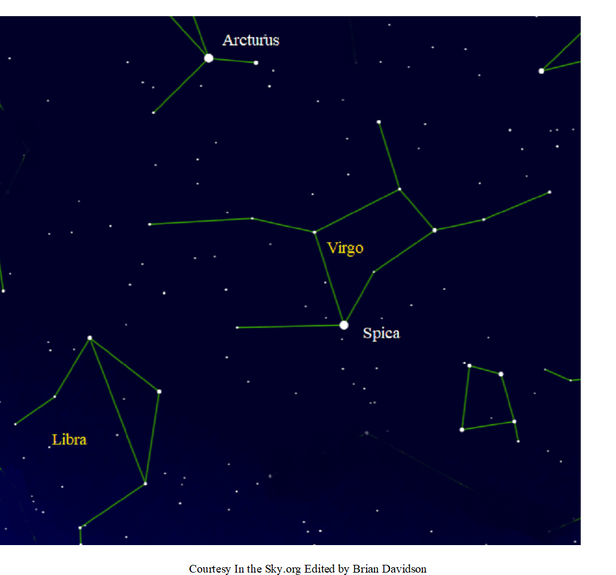 Something to look out for
Venus reaches its greatest eastern elongation on Sunday 4th June so a good time to observe. The angle formed by a line from the Sun through Venus to the Earth is 90 degrees so as viewed from Earth, Venus is half in sunlight half in shadow and this is referred to as ‘dichotomy’. The observation of the phases of Venus through a telescope by Galileo was one of the important discoveries which led to the heliocentric model of the solar system being accepted. For the early risers among you, the earliest sunrise of the year is on Saturday 17th (3.38am BST) and this is followed on Wednesday 21st by the summer solstice in the northern hemisphere when the Sun reaches its highest point in the sky. On Thursday 22nd there will be a close approach of a 4 day old Moon with the planets Venus and Mars and eight days later on Friday 30th Venus and Mars will be within about three and a half degrees of each other in your western sky after sunset. May the clear skies continue.
0 Comments
Leave a Reply. |
AuthorWMA members Archives
July 2024
Categories |
 RSS Feed
Proudly powered by Weebly